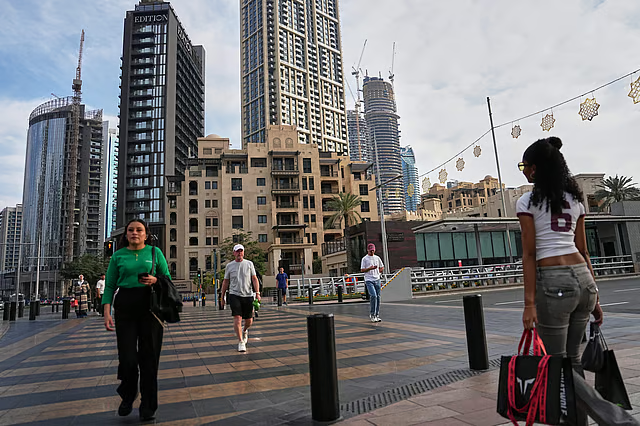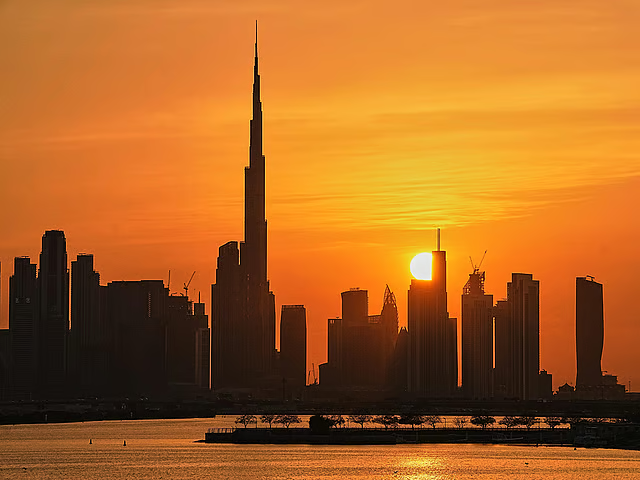
Dubai: Regional geopolitical tensions often raise concerns about economic stability and capital flows. Dubai’s property market has repeatedly demonstrated that uncertainty elsewhere can reinforce the emirate’s position as a destination for global capital.
Recent market activity suggests that pattern continues to hold. Developers, brokers and analysts say investor interest remains steady even as geopolitical tensions dominate headlines across the region.
Transaction volumes, investor enquiries and major deals continue to move through the market, particularly in prime locations and luxury developments.
Built in resilience
Dubai’s property sector has navigated several cycles of global and regional disruption during the past two decades. Each downturn has eventually been followed by a recovery that pushed the market beyond its previous peak.
Firas Al Msaddi, chief executive of fäm Properties, says the city’s track record plays a major role in shaping investor confidence today.
“I launched my company in Dubai in 2009 amid the global financial crisis, and have seen the market negotiate various geopolitical events since then,” he said.
“Every single downturn in Dubai’s real estate history has been followed by a recovery that saw the market surpass the previous peak.”
Past market data support that pattern. The period following the global financial crisis produced a recovery that culminated in strong price growth by 2014. A correction between 2015 and 2019 eventually gave way to another rally that accelerated during the post-pandemic recovery.
Short-term sentiment may fluctuate during geopolitical events, yet the longer trend has consistently been upward.
Safe-haven demand
Dubai’s appeal during uncertain periods rests on several structural advantages. Investors often highlight the emirate’s regulatory framework, political stability and diversified economy.
Tauseef Khan, founder and chairman of Dugasta Properties, said demand often concentrates around quality developments when uncertainty rises.
“Historically, Dubai’s real estate market has shown resilience during periods of regional geopolitical tension,” he said.
“While short-term caution may reduce speculative activity, core demand from both regional and international investors often remains steady, particularly for prime and well-located assets.”
Developers report that projects positioned around infrastructure corridors or established residential hubs continue to attract buyers.
“Transactions tend to concentrate on high-quality developments that offer long-term value and income stability,” Khan said.
Strong governance and investor protection measures also support the market’s appeal. Dubai’s real estate regulatory system has evolved considerably over the past decade, strengthening oversight of escrow accounts, developer licensing and project delivery standards.
Investors often point to these institutional factors when allocating capital during periods of global uncertainty.
Oil prices and macro signals
Another factor shaping sentiment is the region’s macroeconomic backdrop. Rising oil prices often support government spending and liquidity across Gulf economies.
Abdullah Alajaji, founder and chief executive of Driven, Forbes Global Properties, said recent market volatility appears tied to geopolitical events rather than deeper structural issues.
“Recent volatility in oil prices and global markets is likely to be cyclical rather than structural, largely reflecting current geopolitical escalation,” he said.
The UAE’s financial position provides additional stability. S&P reaffirmed the country’s AA/A-1+ sovereign credit rating with a stable outlook earlier this month, highlighting strong fiscal buffers and consolidated net assets equivalent to 184% of GDP.
Dubai’s economy is also far more diversified than in earlier cycles. Non-oil sectors now account for roughly three-quarters of the country’s economic output, reducing the direct link between oil prices and property demand.
“Investor appetite tends to track broader macroeconomic stability and capital availability rather than oil price movements alone,” Alajaji said.
Ultra-prime confidence
One of the most striking signals of investor confidence in recent weeks has come from the ultra-prime segment of the market.
Source : Gulfnews
About the Author