US Government Shutdown and Its Global Impact on Dubai’s Economy and Real Estate Market
The US government officially entered shutdown mode after midnight on Wednesday, following a budget impasse between lawmakers and President Donald Trump. The deadlock, fueled by disagreements over Democratic demands for healthcare funding, has resulted in the suspension of work across multiple federal departments and agencies — directly affecting hundreds of thousands of U.S. government employees.
This marks the first shutdown since the record-breaking 35-day closure nearly seven years ago, which disrupted major government services. Analysts warn that the latest political standoff could trigger global economic uncertainty, with ripple effects extending as far as Dubai’s financial markets, real estate investments, and tourism sector.
Political Deadlock and Rising Tensions
Trump blamed Democrats for the stalled negotiations and threatened significant public sector job cuts during the shutdown. His remarks added to the anxiety of federal workers, many of whom had already been shaken by earlier large-scale layoffs under Elon Musk’s newly created Department of Government Efficiency.
Congress failed to pass a short-term funding extension, with Democrats opposing the House-passed measure that excluded billions in healthcare support for low-income families under Obamacare. As a result, 750,000 federal employees could be furloughed daily, with salaries withheld until the shutdown ends.
Why Dubai is Watching Closely
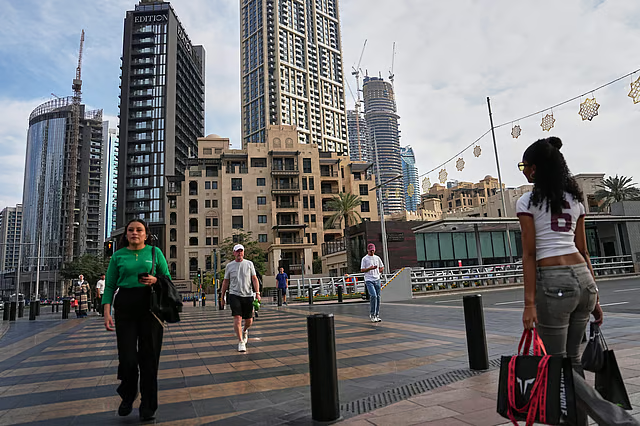
Although based in Washington, the shutdown has implications for global markets. Investors in Dubai real estate and the UAE stock market monitor U.S. political stability closely, as America’s fiscal health often influences oil prices, currency flows, and investor confidence.
Dubai, however, has built a reputation as a safe-haven for global investors. During times of political and economic instability abroad, international buyers increasingly turn to Dubai’s property market and long-term residency visas (such as the Golden Visa) to safeguard their wealth.
Lessons for Dubai
While the U.S. shutdown reflects the risks of political gridlock, Dubai continues to showcase its strength in economic diversification, governance, and resilience. With thriving sectors like real estate, tourism, logistics, and aviation, the city remains a stable hub for global business, even when other economies falter.
FAQs: US Government Shutdown and Its Impact on Dubai
1. How does a US government shutdown affect Dubai?
While the shutdown occurs in the U.S., it can create global economic uncertainty, influencing oil prices, currency exchange rates, and international investment flows. Dubai, as a global business hub, monitors these trends closely, especially in real estate, tourism, and financial markets.
2. Will Dubai real estate be affected by the US shutdown?
Dubai’s real estate market is relatively insulated from U.S. political crises. In fact, during periods of global instability, investors often seek Dubai property as a stable and high-return investment, benefiting from options like long-term Golden Visas and tax advantages.
3. Why do investors view Dubai as a safe haven?
Dubai is renowned for political stability, robust infrastructure, and a diversified economy. Even when global markets experience turmoil, Dubai continues to attract international investors and expatriates seeking security, lifestyle, and wealth preservation.
4. Could Dubai tourism be impacted?
Indirectly, yes. Global uncertainty may temporarily reduce outbound travel from some regions, but Dubai’s tourism sector is supported by mega-events, luxury attractions, and initiatives like the Unified GCC Tourist Visa, making it resilient against global crises.
5. How does Dubai maintain stability during global crises?
Dubai’s government emphasizes strong governance, economic diversification, and strategic planning. With thriving sectors including real estate, aviation, logistics, tourism, and hospitality, Dubai continues to remain a secure destination for residents, businesses, and tourists alike.
Source : Khaleejtimes