Every tall building starts with an idea, but only a few become symbols that change how cities look at themselves. These are the ones that cost billions, not because of showy lights or fancy marble, but because they mix innovation, luxury, and purpose in one frame. You see engineering on one side and pride on the other. That balance makes them rare.
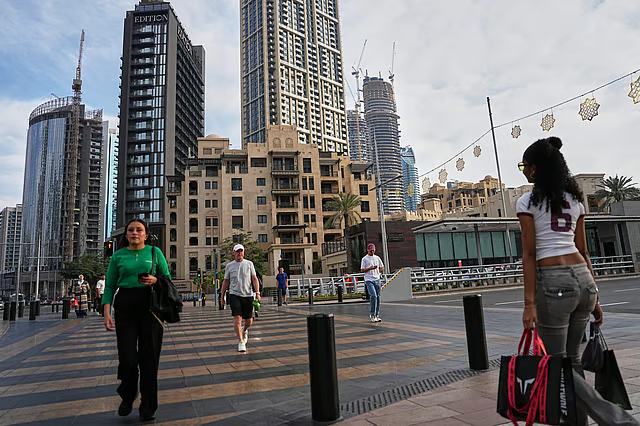
Across the world, architects and investors chase this mix: height, design, prestige. Some want the tallest, some the most complex, and a few just want to be remembered. That’s where the price keeps climbing, quietly. And no surprise, Dubai stands right at the front of that line again. Our skyline has turned into a record book itself, from the Burj Khalifa to The Royal Atlantis and more waiting to rise.
As we look at the most expensive buildings in the world in 2025, the pattern is clear. Innovation costs money, and cities ready to spend it end up defining what progress looks like. Dubai continues to dominate this story with structures that combine ambition, artistry, and real estate strategy in one frame. Let’s walk through the billion-dollar landmarks that set today’s global standard.
How Buildings Are Ranked by Cost
There’s no magic behind those billion-dollar numbers. Every tall structure you see is built from sweat, skill, and long nights that stretch into years. Each project tells a story of money turning into metal, glass, and patience. Costs don’t just show up. They grow slowly, one plan at a time. Sometimes even the planners lose count halfway. That’s how we see it anyway.
1. Construction and Material Costs
Cement, steel, cables, cranes, labour, each adds its weight. A single slab of glass used in a tower could cost more than a car. When height rises, safety rules multiply. That’s when the budget starts breathing heavily.
2. Architectural Innovation and Technology
Think of motion dampers, sustainable cooling, and AI-assisted monitoring. When architects chase new records, budgets follow them upward.
3. Location and Land Value
Prime land doubles the spend before a brick is laid. Downtown Dubai or Palm Jumeirah real estate often accounts for a huge slice of the cost.
4. Purpose and Use
Hotels, offices, and mixed-use landmarks all ask for different finishes. One needs marble, another needs mirrored lifts. The richer the crowd it serves, the longer the bill grows. Not all buildings are meant to save cost; some are built to start conversations.
5. Maintenance and Sustainability Plans
Modern skyscrapers budget years ahead for cleaning systems, solar integration, and cooling efficiency. The true costliest building ever made is often the one that stays efficient the longest.
Dubai’s Marvels: The World’s Most Expensive Buildings
1. Burj Khalifa – Dubai, UAE (~$1.5 Billion)
Still unmatched in height, the Burj Khalifa stands at 828 meters. We see it daily, yet it still feels unreal.
Overview: The tower mixes offices, the Armani Hotel, and private residences.
Features: 154 floors, sky observatories, lightning-safe façade, and precision cooling systems.
Why It’s Expensive: Each floor uses reinforced concrete built for seismic safety; wind tunnel tests alone ran into millions.
Interesting Fact: At its opening, unit sales here were among Dubai’s most expensive properties per square foot. The Burj remains the most expensive building in Dubai by total spend and symbolic weight.
2. The Royal Atlantis Resort & Residences – Dubai, UAE (~$1.7 Billion)
A floating vision on Palm Jumeirah. Each curve hides engineering precision.
Overview: Luxury resort and residence development by Kerzner International.
Features: Nearly 800 keys, 90 swimming pools, and a sky bridge that glows at night.
Why It’s Expensive: Hand-crafted interiors, imported marble, custom ventilation, and water-theatre designs.
Highlight: Opened with a show that made global headlines, cementing its name among the world’s most expensive construction projects. It’s more than hospitality; it’s an ecosystem of taste, service, and artistry.
3. Marina 101 – Dubai, UAE (~$1 Billion)
Once delayed, it is now nearing its long-awaited finish.
Overview: 425-meter tower with 101 levels, combining apartments and a hotel.
Features: Sky lobby, spa floors, and separate residential zones.
Construction Note: Over the years, rising material costs and spec changes pushed final spend close to $1 billion. Together, these three towers define how Dubai continues to lead global cost charts. For us, it’s proof that pushing limits, even financially, still pays back in prestige.
Why Dubai Leads the Billion-Dollar Architecture Race
Because we never settle. Dubai has turned construction into performance art. Investors trust us because our projects stand tall, literally and financially.
According to the Julius Baer Global Wealth & Lifestyle Report 2025, Dubai climbed to 7th place among the world’s most expensive cities for affluent living, moving up from 12th just a year ago. The ranking measures the cost of luxury property, goods, and services. It shows what we already see daily, premium living here isn’t by accident, it’s by design.
We combine land strategy and design innovation. Each tower must be iconic enough to attract global capital. Add government support for urban expansion, and you get an ecosystem that keeps breeding the most luxurious skyscrapers in the world.
From smart glass that reduces heat load to record-long cantilevers at One Za’abeel, our projects blend tech and aesthetic like few cities can. That’s why the costliest hotel and commercial buildings so often start here.
Future Multi-Billion Projects to Watch (Dubai & Beyond)
Even with towers this tall, the sky isn’t a limit for us. Below are upcoming projects that might rewrite next year’s rankings.

Dubai Creek Tower (UAE): Designed to surpass Burj Khalifa, currently under design revisions. Projected multi-billion-dollar budget.
NEOM – The Line (Saudi Arabia): The largest linear smart city plan ever, estimated at $500 billion.
Jumeirah Marsa Al Arab (Dubai): A $1.3 billion luxury hotel project resembling a superyacht.
One Za’abeel (Dubai): Twin towers connected by “The Link,” the world’s longest cantilever.
Kingdom Tower (Jeddah): Expected to reach 1 kilometer in height on completion.
These future concepts prove how the Middle East remains at the center of the world’s most expensive construction projects. The moment they open, rankings will shift again.
What Makes These Buildings So Expensive
Every time someone asks why a tower costs billions, we say, it’s not only size. Its complexity.
Height and Span: As you go up, structural weight increases exponentially. Burj Khalifa needed wind testing, which had never been done before.
Systems: Mechanical and fire safety integration alone can eat hundreds of millions.
Design: High-end interiors like those in Atlantis or Wynn Palace push aesthetic and budget together.
Location: Premium plots mean tighter construction schedules and costly permits.
Labor Skill: Specialized teams fly in for glass installation or steel welding at extreme heights.
To build the most expensive building in the world, you first need the courage to think that big.
Economic and Cultural Impact
Every billion spent echoes through local economies. Skilled labor arrives, new districts form, property values rise. Tourism thrives. Marina Bay Sands and Atlantis proved how architecture can drive GDP.
In Dubai, our expensive towers in the UAE are not vanity projects. They’re engines that pull entire industries forward, from real estate to hospitality and design. When one tower opens, hundreds of businesses benefit.
Culturally, these structures become national symbols. People visit to feel part of that grandeur. It’s why Dubai’s skyline keeps appearing in films, art, and social media feeds. That’s brand value you can see from space.
Final Thoughts
The global chase to build the most expensive building in the world never really stops. But somehow, Dubai keeps staying ahead. From Burj Khalifa to The Royal Atlantis, each landmark tells the same story: our belief in scale, precision, and pride. The city doesn’t copy; it sets the rhythm for others to follow.
At Driven Properties, we see what those numbers truly mean: lasting value, not just headlines. When you invest here, you invest in legacy, comfort, and confidence. Our team helps you choose from Dubai’s most expensive properties or growing developments that carry long-term strength.
Contact us today. Let’s talk about your next address, your next investment, maybe even your view from Dubai’s next billion-dollar tower.
Frequently Asked Questions:
1. Which is the most expensive building in the world in 2025?
Right now, Abraj Al-Bait in Mecca stays on top. Around $15 billion has been spent already. It’s still listed among the most expensive buildings in the world in 2025, no contest.
2. Which is the most expensive building in Dubai?
Burj Khalifa continues to hold that title. It cost roughly $1.5 billion to rise. For years, people have called it the most expensive building in Dubai, and rightly so.
3. Why are buildings in Dubai so expensive to construct?
Because quality needs money, premium materials, smart systems, and imported design all add up. That’s why we lead the world’s most expensive construction projects with pride, not by accident.
4. Is Burj Khalifa still the tallest building in the world?
Yes, still the tallest. 828 meters touching clouds. Even with new ideas like Jeddah Tower, it stays iconic, and the most expensive building in the world is still admired daily.
5. What upcoming projects could surpass Burj Khalifa?
Dubai Creek Tower and Kingdom Tower in Jeddah are being watched closely. Both aim for record height and design. They may soon join the most expensive buildings in the world 2025 list.
6. Which country has the most expensive buildings overall?
Saudi Arabia leads with Abraj Al-Bait, then Singapore and Dubai follow. Each hosts the costliest building ever made, turning architecture into an economy. Every tower there tells a story of money and mind.
7. Are these buildings profitable?
Profit depends on purpose. Hotels earn from tourism, offices from tenants, and icons from prestige. Sometimes, brand value itself is enough for a return. We see that with many expensive towers in the UAE already.
About the Author