Israel’s Operation Rising Lion Reshapes Middle East Strategy Amid Iran Tensions
The Middle East is once again at the epicenter of global attention following a bold and unprecedented military and intelligence operation by Israel against Iran — a campaign now being called Operation Rising Lion. The ripple effects of this conflict are already reaching countries such as the United Arab Emirates, India, Pakistan, and the United States, while global security analysts closely monitor every move.
A Widespread Strike Unfolds
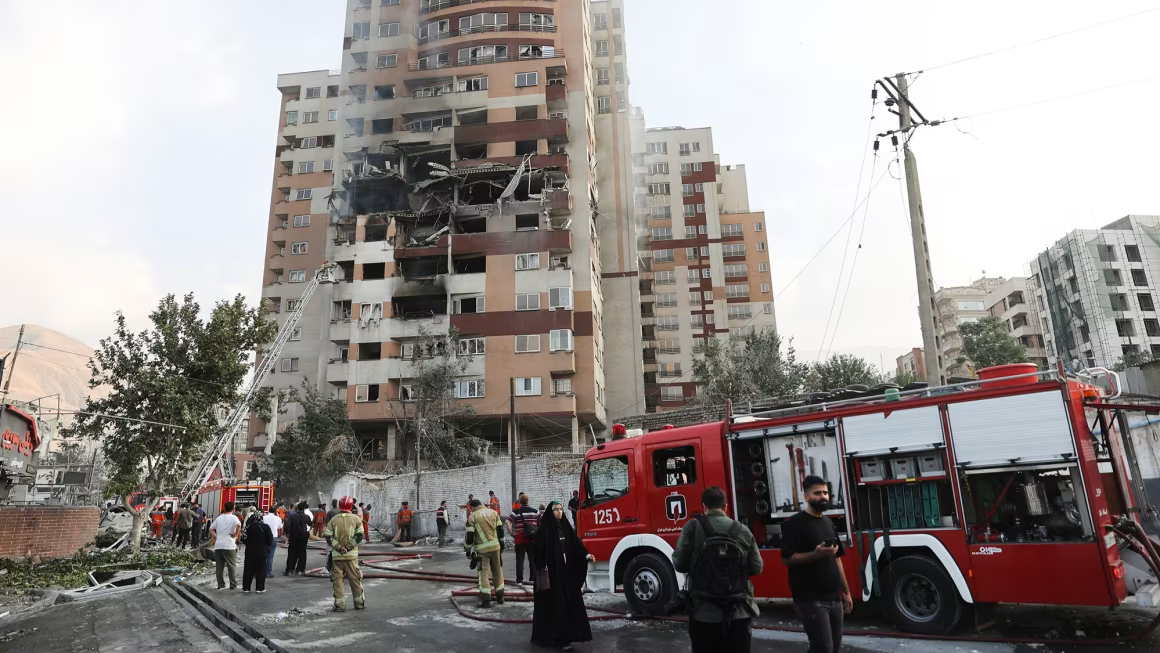
The scale and complexity of Israel’s coordinated attack on Thursday night took observers by surprise. Airstrikes, covert operations, and sabotage across multiple Iranian cities reportedly led to the elimination of Iran’s top military commanders, missile and drone leaders, and key figures supporting Iran’s regional proxies. According to regional analysts, this was not just a targeted hit — it was a sweeping decapitation of Iran’s military command structure.
The operation, while rooted in a long-standing conflict, reflects a shift in Israel’s posture. Following the devastating Hamas-led attack on Israel on October 7, 2023, supported by Iranian-backed groups, Israel has vowed to respond aggressively to any perceived threats from within or outside its borders — a move that resonates across Pakistan, India, and the Gulf states where regional security is intricately tied to Middle East stability.
Intelligence Supremacy and Air Dominance
Israel’s successful neutralization of Iran’s key military figures within hours highlights a striking level of intelligence penetration. According to defense experts, the destruction of Iran’s air defense systems, initially weakened during last year’s Israeli retaliation to Iranian missile attacks, has allowed Israel to now assert air dominance over Iranian territory — a capability with massive strategic consequences.
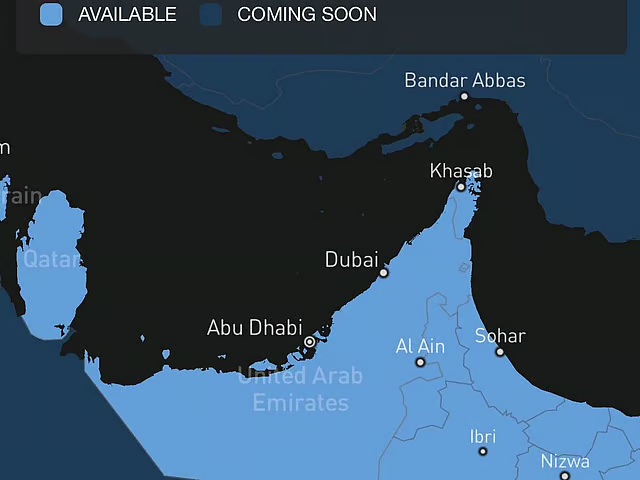
Officials across Abu Dhabi, Islamabad, and New Delhi are watching closely, as any further escalation could threaten energy corridors, especially through the Strait of Hormuz, a vital route for South Asia’s and the UAE’s oil supply.
Iran’s Strategic Miscalculation Post-October 7
Iran’s decision to escalate its involvement following Hamas’s attack last year has turned out to be a serious strategic error. Tehran supported Hezbollah in Lebanon, supplied militants in Iraq, Syria, and Yemen, and twice launched massive drone and missile assaults on Israel. Each time, the responses were coordinated between Israel, the United States, and regional partners, including defense coordination from the White House.
Simultaneously, Iran escalated its nuclear enrichment efforts, drawing sharp criticism from international watchdogs. Just last week, the International Atomic Energy Agency (IAEA) declared Iran in “egregious violation” of its nonproliferation commitments. In a rare diplomatic rebuke, 19 nations, including several that maintain ties with India and the UAE, voted to censure Iran — leaving Russia, China, and a few others in support of Tehran.
Regional Implications: UAE, India, Pakistan & the West
For India and Pakistan, both reliant on Gulf oil and home to millions of expatriates working in the UAE and Saudi Arabia, further instability could directly affect fuel prices, remittances, and regional trade. The United Arab Emirates, a growing regional power and a key player in de-escalation diplomacy, is expected to play a role in backchannel efforts to prevent further destabilization.
Meanwhile, Canada and the United States, which have deep economic and military ties in the region, are committed to defending Israeli interests. U.S. support, spanning both Democratic and Republican administrations, has emboldened Israel’s strategic maneuvers.

What Comes Next?
By Friday, Iran launched hundreds of ballistic missiles in retaliation, calling it the beginning of a “crushing response.” While much of the international community remains focused on diplomatic containment, the military momentum currently lies with Israel. Iranian replacements for the slain commanders face immense pressure, knowing they, too, could become targets.
This confrontation is no longer a series of isolated incidents. It’s part of a broader reordering of the Middle East, with consequences for South Asia, the Gulf, and the West. As things stand, UAE, India, Pakistan, and others must navigate a fragile geopolitical landscape where one misstep could provoke a wider regional conflict.
According to CNN’s global affairs analyst Brett McGurk, who has advised U.S. Presidents across four administrations, this crisis was long in the making — and its trajectory now hinges on whether Iran abandons its nuclear ambitions and Hamas ceases its militant activities. Until that happens, Israel appears determined to defend its national security with force — and the United States, along with its regional allies, is likely to stand by it.
About the Author